







What is Phragmites?
The term “Phragmites” refers to a tall, perennial species of wetland grass named Phragmites australis. Phragmites is also known by the name “common reed.” Native Phragmites (Phragmites australis spp. americanus) is a common fixture of wetlands, shorelines, and ditches throughout Minnesota. However, a non-native (invasive) variety of Phragmites (Phragmites australis spp. australis) is also being detected throughout Minnesota and is requiring management from organizations like MPRB. Both the native and non-native varieties of Phragmites are found in Minneapolis, although the difference between the two types can be difficult to distinguish without training.
Why is Phragmites a problem?
According to the University of Minnesota Aquatic Invasive Species Research Center (MAISRC):
“Invasive Phragmites is an ecosystem engineer that benefits from human-caused disturbances on the landscape. Invasive populations in North America have been shown to alter the hydrology of wetland systems, lower plant diversity, impact food webs, and reduce diversity and abundance of invertebrates, fish, and waterbirds.”
In short, invasive Phragmites has the potential to make local lakes and wetlands less hospitable for desirable species of plants and animals.
Invasive Phragmites can reproduce and spread both sexually (by seed) and asexually (by rhizome, stolon, and stem fragments). This makes invasive Phragmites a very difficult plant to contain in a small area.
Also, since mature Phragmites plants can grow to a height of 15 feet tall or more, they can serve as a significant aesthetic nuisance along lake shorelines.
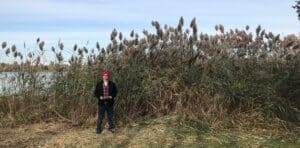
Above: Environmental Management staff member in front of invasive Phragmites at Lake of the Isles.
Where is invasive Phragmites located in Minneapolis parks?
Multiple sites of invasive Phragmites have been surveyed by MPRB staff and confirmed by experts at MAISRC:
- Two sections of a wetland on the south side of Wirth Lake.
- A portion of the shoreline on the south side of Lake of the Isles near the MPRB dog park
- A portion of the shoreline west of Thomas Beach on the south side of Bde Maka Ska
- A stretch along the channel connecting Bde Maka Ska to Lake Harriet near William Berry Parkway
- The Minneapolis Sculpture Garden
Does MPRB have any legal obligation to manage sites of invasive Phragmites?
Yes. Invasive Phragmites is on the control list of the Minnesota Department of Agriculture (MDA)’s Noxious Weed List. According to the MDA, “Species on this list must be controlled, meaning efforts must be made to prevent the spread, maturation and dispersal of any propagating parts, thereby reducing established populations and preventing reproduction and spread as required by Minnesota Statutes, Section 18.78.”
Why hasn’t MPRB done anything to manage invasive Phragmites until now?
Before 2021, invasive Phragmites was listed in the restricted category of the state’s Noxious Weed List. At that time, management of invasive Phragmites was not legally required. Invasive Phragmites was elevated to the control list for 2021, meaning that MPRB is now legally obligated to manage it.
What strategies exist to manage Phragmites and what is being planned for the three surveyed sites in Minneapolis?
According to MAISRC: “For long-term control of non-native Phragmites, mowing alone, burning alone, grazing alone, or covering with black plastic are not effective.” Instead, the most effective management strategy for invasive Phragmites involves:
Summer mow (optional) –> Fall herbicide –> Winter mow –> Evaluate –> Follow-up treatment
This treatment cycle is generally used for three consecutive years with revegetation occurring, if necessary, on the fourth year.
To manage the existing populations of invasive Phragmites, MPRB is planning to follow MAISRC’s recommended management approach.
What is the goal of MPRB’s invasive Phragmites management program?
The goal for these and future invasive Phragmites populations in the MPRB system is controlling the species, preventing it from spreading, maturing, dispersing, and causing damage to infrastructure, and protecting sensitive natural resource areas.
MPRB is planning for three years of mowing the invasive Phragmites sites and treating them with herbicide. The sites will be surveyed each year and will be revegetated with native species when treatment is complete. The revegetation species will be chosen to complement the existing plant community at each of the sites.
Who will be completing the invasive Phragmites treatments in Minneapolis?
MPRB has entered into agreements with licensed herbicide applicators who have many years of experience conducting herbicide treatments of invasive Phragmites and other aquatic invasive species. The applicator will follow all local, state, and federal guidelines and permitting requirements for conducting herbicide treatments.
How will I know if an area has been treated for Phragmites?
Informational signage will be posted at each of the sites by the applicator and will remain visible until 48 hours after the treatment occurs.
Is herbicide management of Phragmites safe for humans, pets, and the environment?
The herbicide being used for the Phragmites treatments is called imazapyr (trade name: Habitat). Imazapyr is a systemic herbicide that works by inhibiting the production of an enzyme that is essential for plant growth but is not found in animals including humans. After plants are treated, they stop growing and decompose over the course of several months. Imazapyr does not pose risks to animals, but it can kill non-target plants if it drifts on the wind.
The herbicide applicator is very experienced with using imazapyr and will take special precautions to ensure that non-target plant damage does not occur. For example, the applicator will be using a precise method of backpack spraying that only applies the herbicide where it is needed and minimizes the risk of risk of extra herbicide damaging non-target plants.
These factsheets from the Minnesota Department of Natural Resources [PDF] and the Wisconsin Department of Natural Resources [PDF] contain additional information about imazapyr.
If new Phragmites sites are discovered on MPRB property in the future, will they be managed this same way?
MPRB will make management determinations on a site-by-site basis. MAISRC’s recommended management techniques may change in the future as additional research on Phragmites management is conducted. MPRB plans to stay up to date with MAISRC’s recommendations to ensure that the most effective and environmentally friendly management techniques are being utilized.
What should I do if I find what I think is invasive Phragmites somewhere in a Minneapolis park?
If you think you have found invasive Phragmites in a Minneapolis park, you can follow MAISRC’s Reporting Instructions document to confirm its identity, collect a sample, and report it. MPRB will be alerted to any new populations of invasive Phragmites that you find and report using this protocol.
Will the Phragmites treatment next to the Turtle Nesting Study Area at Thomas Beach (Bde Maka Ska) hurt the baby turtles?
Staff have carefully reviewed the herbicide and procedures to be used at this site with the contractor. The herbicide is approved for shoreline and aquatic use and will be spot treated directly to the Phragmites plants with minimal to no impact on the local turtle population.
Managing invasive Phragmites at Bde Maka Ska will help protect turtle nesting habitat near Thomas Beach. If left untreated, the Phragmites would continue to spread through this area and make it unusable for nesting.