







Cleveland was a landscape architect who created framework for today’s Minneapolis park system in landmark 1883 document, “Suggestions for a System of Parks and Parkways for The City of Minneapolis”
Posted on 27 October, 2023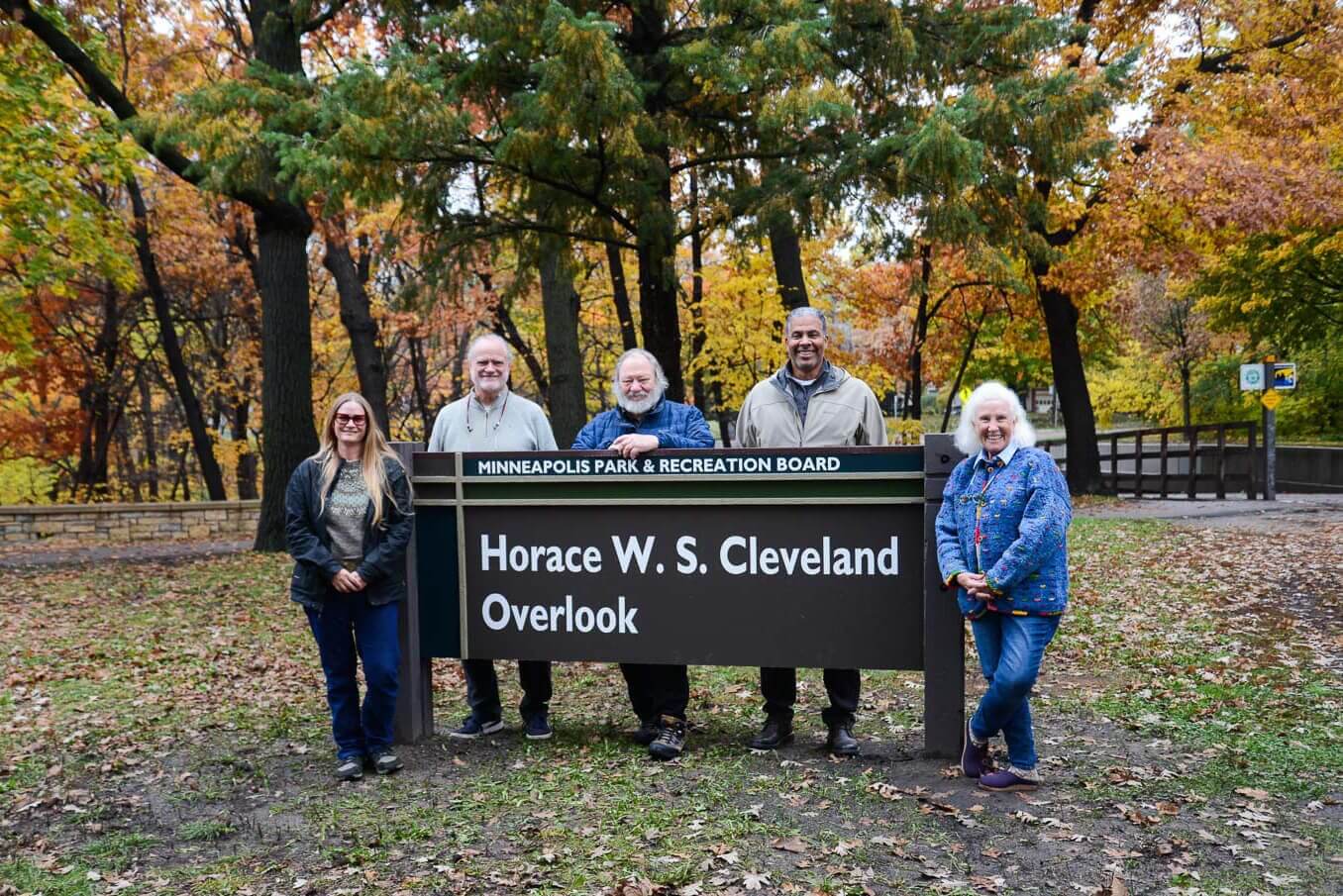
L to R: MPRB District 5 Commissioner Steffanie Musich, author and park historian David C. Smith, former District MPRB District 3 Commissioner Scott Vreeland, MPRB Superintendent Al Bangoura, MPRB President Meg Forney
On Wednesday, Oct. 18, 2023, Minneapolis Park and Recreation Board (MPRB) Commissioners voted to name a previously unnamed overlook near the intersection of West River Parkway and East 44th Street the “Horace W. S. Cleveland Overlook.” The following Wednesday, Oct. 25, 2023, MPRB trades staff installed new signage bearing the overlook name.
Horace William Shaler Cleveland was a landscape architect hired in April 1883 to advise the newly created Minneapolis Park Board on the development of a park system for Minneapolis. On June 2, 1883, Cleveland read a document to the Board of Commissioners that would provide the framework for today’s Minneapolis park and recreation system. That document was called Suggestions for a System of Parks and Parkways for The City of Minneapolis.
In the ensuing decades, the Minneapolis Park Board persistently pursued and expanded on Cleveland’s initial vision for a network of public parkland and parkways connecting Minneapolis’ beautiful riverfront, lakes, creeks and forest. Today the Grand Rounds National Scenic Byway contains more than 50 miles of continuous, parallel parkway and trail running throughout the Minneapolis park system. It was designated as a National Scenic Byway by the Federal Highway Administration in 1998.
“What makes the Minneapolis park system truly special is that we’re not only blessed with incredible natural resources – the Mississippi River, Chain of Lakes, Minnehaha Creek, Minnehaha Falls, the forest within Theodore Wirth Regional Park – but that these resources have been preserved as public land, available for everyone to enjoy,” said Al Bangoura, Superintendent of the MPRB. “All of that is built on Horace Cleveland’s initial vision and the determination and hard work of generations of Minneapolis park commissioners, staff and supporters who believed in that vision.”
The Horace W. S. Cleveland Overlook is near the parking lot just north of the intersection of West River Parkway and East 44th Street. It offers a view of the river bluffs in Mississippi Gorge Regional Park and is near access to Winchell Trail, a five-mile hiking route along the riverfront and bluff areas in the park.
“Recognition for Cleveland and his vision for our amazing park system has been long in the making,” said Meg Forney, President of the MPRB. “I’m grateful for the work of the visionaries like Cleveland and the park stewards who came before me so that our most valuable land and waterfront was acquired and maintained for all.”
“I also want to recognize David C. Smith for his work in documenting the history of the Park Board and Cleveland’s contributions,” added Forney.
Smith is the author of “City of Parks: The Story of Minneapolis Parks” which was published in 2008 to commemorate the 125th anniversary of the Minneapolis Park Board. He also writes about Minneapolis park history on his blog, Minneapolis Park History. Smith once wrote that “Cleveland [is] responsible more than any other for Minneapolis eventually being one of the greenest cities in the United States with one of the best park systems.”
Steffanie Musich, MPRB Commissioner for District 5, which includes the area of South Minneapolis where the overlook is located, notes Cleveland’s prescient vision for preserving the riverfront as parkland in his original presentation of Suggestions for a System of Parks and Parkways for the City of Minneapolis:
“The Mississippi River is not only the grand natural feature which gives character to your city and constitutes the main spring of prosperity, but it is the object of vital interest and center of attraction to intelligent visitors from every quarter of the globe, who associate such ideas of grandeur with its name as no human creation can excite,” wrote Cleveland. “It is due therefore, to the sentiments of the civilized world, and equally in recognition of your own sense of the blessings it confers upon you, that it should be placed in a setting worthy of so priceless a jewel.”
“As a river advocate and Commissioner who greatly treasures and appreciates the one true gorge on the great Mississippi River, we all owe a great debt to Cleveland,” said Musich.
The overlook is part of a section of riverfront acquired by the MPRB in 1901 after nearly two decades of planning and advocacy in the wake of Cleveland’s plan. Cleveland called it “a continuous park of such picturesque character as no art could create and no other city can possess.”