







The public is invited to join victims/survivors and allies to celebrate the completion of the nation’s first permanent public memorial to honor survivors of sexual violence, located at Boom Island Park, with a virtual event on Saturday, October 10, at 10 am.
Posted on 9 October, 2020
The public is invited to join victims/survivors and allies to celebrate the completion of the nation’s first, permanent, public memorial to honor survivors of sexual violence, located at Boom Island Park, with a virtual event on Saturday, Oct. 10, at 10 am. Keynote speakers include Tarana Burke, activist and founder of the Me Too movement, and V (formally Eve Ensler), activist, author and playwright best known for “The Vagina Monologues.”
View the event on Facebook Live
Due to COVID-19, this is a virtual event, not an in-person gathering. However, the Survivors Memorial is now open to the public and can be visited any time. Boom Island Park is located along the Mississippi River at 724 Sibley St. NE, Minneapolis. The memorial is located at the south end of the park, between the playground and bridge to Nicollet Island.
Sarah Super launched the initiative for the memorial to honor survivors of sexual violence in 2015, only weeks after her ex-boyfriend broke into her home, hid in a closet, then woke her at knifepoint and raped her. He was sentenced in Ramsey County to 12 years in prison for his crime.

Sarah Super
The Memorial was inspired by the hundreds of stories survivors shared with Super after she publicly identified herself as her ex-boyfriend’s rape victim. Super was also inspired by the work of Dr. Judith Herman, one of the country’s leading experts on psychological trauma and abuse.
“When I first spoke out about being raped, a lot of people said and did nothing. Their silence taught me that there is no such thing as a neutral response to sexual violence. A response will either be hurtful or healing. Silence is not neutral. Silence supports the perpetrators and never the victims,” states Super.
“The Memorial is one way community members have taken a stand and voiced their support for those who’ve been victimized. Our goal was to break the silence and respond to sexual violence and rape culture as a community in solidarity with victims/survivors.”
The Memorial design team includes: Sarah Super, landscape architects Joan MacLeod, Rachel Blaseg, and Jennifer Germain of Damon Farber Landscape Architects, a landscape architecture and planning firm based in Minneapolis, and mosaic artist Lori Greene of Mosaic on a Stick.
The Memorial is a symbol of the community’s solidarity with victims/survivors. Their experiences are honored using two metaphors: a ripple effect and mosaic. The circle of benches is intended as an invitation for dialogue. The ripple effect seen in the seating platform and extending into the landscape signifies the multiplying power of survivors’ voices; when survivors tell their stories, they unconsciously inspire other survivors to tell theirs, who inspire others to tell theirs. The mosaics symbolize that broken pieces can be put together to create something whole and beautiful. (more detail on the design elements below)
Notable donors to the Memorial include Gloria Steinem, V (formally Eve Ensler), Nora McInerny, Congresswoman Ilhan Omar, and the law firm of Jeff Anderson & Associates.
The Memorial team also thanks JE Dunn – memorial construction and Propel Nonprofits – fiscal sponsor.
Visit www.survivorsmemorial.org for more information.
Memorial for Survivors of Sexual Violence Design Intent
The Minneapolis Park and Recreation Board was an early supporter of the project offering several park sites to be considered for use by the Memorial. The final site was chosen as an ideal setting for its stunning view of downtown Minneapolis, its proximity to existing recreation paths and secure visibility. The Memorial, which stands on the land of the Dakota Oyate, seeks to bring awareness to the high level of sexual assault experienced by indigenous people.

Three Monuments
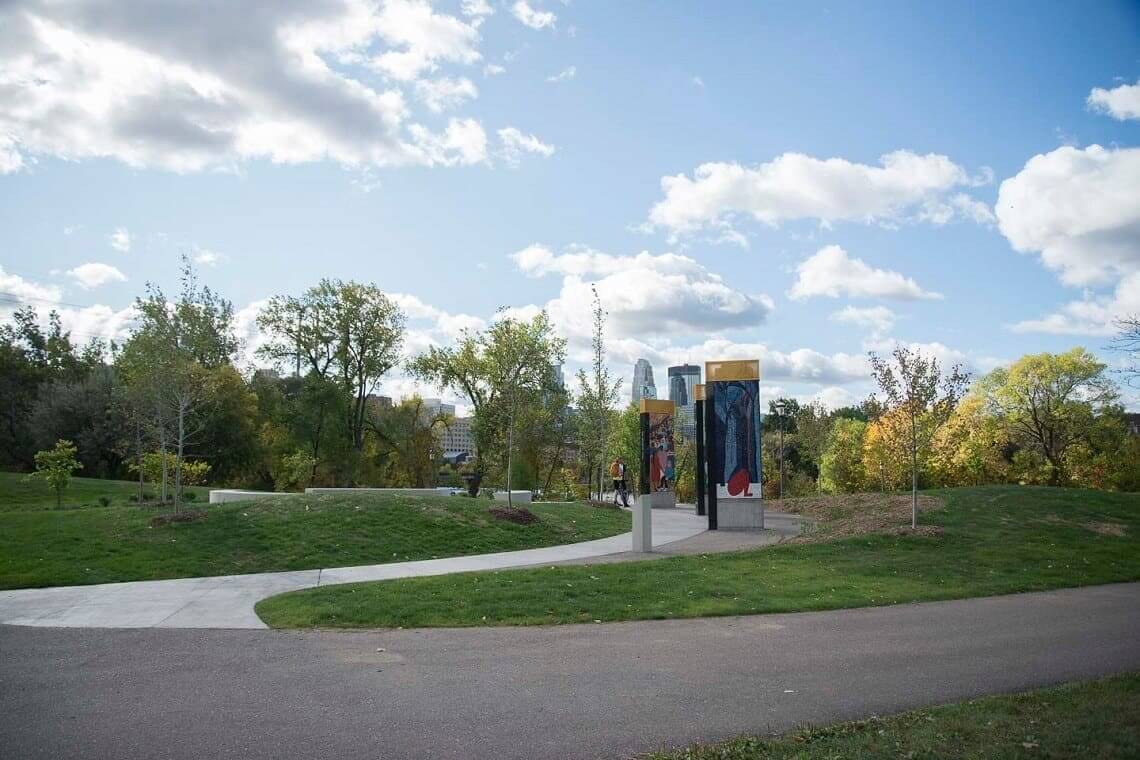
The base of each column is made of grey textured concrete representing the colorless and raw emotions experienced by survivors. Emerging from these bases are three columns of colorful mosaics, each face representing a page for each survivor to share a story, collectively becoming books or columns. The mosaics are designed by sexual survivor and mosaic artist Lori Green and express the journey from feeling alone and frightened back toward connections within community. The choice of mosaic as a medium represents how pieces of shattered glass can come together into something beautiful and lasting.
Along the edge of each column is a polished black granite spine engraved with words of support – You are Not Alone, I Believe You, We Stand with You. Each of these polished spines reflect back our image as community members and allies of survivors as we walk past each column. We are invited to participate in the survivors’ journeys and become allies in bringing our voice to this issue and standing with survivors in solidarity.
Each column is capped with a crown illuminating the journey and providing a thousand points of light of hope.

The Circle
As we pass the last column, we are led into a circle first crossing a threshold of broken stone paving representing shattered lives and communities and into the circular gathering space.
The plaza floor of colored concrete is sandblasted in a pattern of rippling rings like water, that radiate outward overlapping each other. Each ripple represents the courage of each survivor to break the silence and share their story, giving courage to others to share their story of survival.
The plaza is enclosed by a series of precast benches and are an invitation for us to gather, converse, listen and share. Several exits are provided to allow for visual and physical choice and safety.
Landscape
The plaza is supported by the sculpting of the earth to embrace and nurture those who enter the plaza. Plants were chosen to provide low water and low maintenance options while providing a soft framework of color and texture to compliment the Memorial. White poplar trees focus attention toward the Mississippi River and create a veiled enclosure. Their interlaced root structures provide a community of support always present at the site. Additional flowering trees bring color for vibrancy.