








Minneapolis lakes are visited by millions of people every year. The Minneapolis Park and Recreation Board (MPRB) works hard to balance environmental health and recreational value as it cares for the city’s wonderful lakes.
These waterbodies undergo dramatic changes each spring after ice melts and the temperature begins to rise. Algae is one of the most common topics we receive questions on each spring.
Identifying Algae
While each Minneapolis lake has distinct conditions – different water depths, shoreline conditions, habitats – algae grows at all of them, even at this time of the year.
Just like aquatic vegetation, algae grows rapidly in spring as ample sunshine and warmer temperatures rapidly warm lake water. Algae growth can even occur even under lake ice. In March this year, Minneapolis had several days with high temperatures of 70 degrees or more, so some algae species may have an already significant presence early in the season.
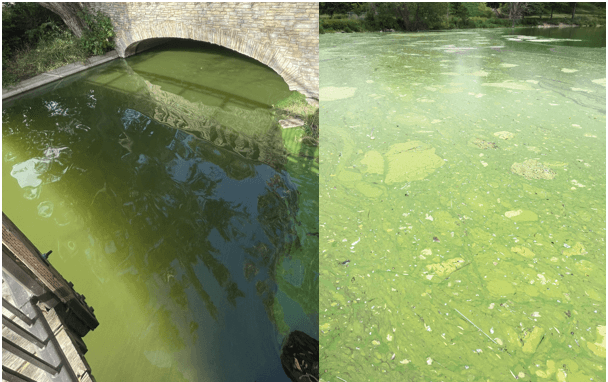
Blue-green algae
Blue-green Algae
Blue-green algae, a type of bacteria called cyanobacteria, are one algae type that can grow any time of year, even under under lake ice.
It can produce toxins that are harmful to both animals and humans, so adults, children and animals should avoid contact with water with blue-green algae. Tips for staying safe around suspected blue-green algae blooms:
- When in doubt, stay out!
- Don’t swim if you can’t see your feet in knee-high water.
- If you’ve recently been in contact with an algae bloom, make sure to wash off with fresh water.
- Watch for signs of recent blooms, such as green scum on the shoreline.
- Don’t let dogs drink or swim in the water. Keep them from eating debris that has washed up on the shore.
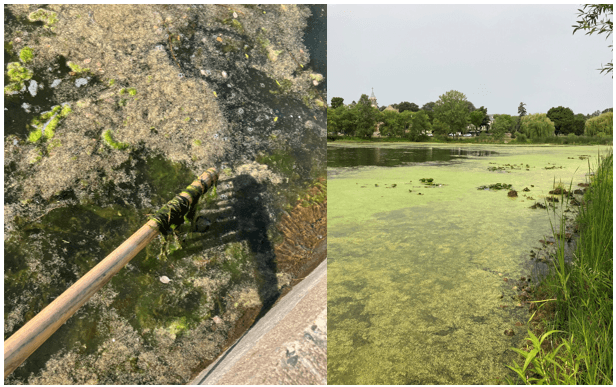
Filamentous algae
Filamentous Algae
Filamentous algae is not toxic. It provides habitat for aquatic insects, snails, and other animals that are valuable fish food. However, with rapid springtime growth, it forms greenish, stringy mats on the water surface that can be an unsightly nuisance for boating and other water recreation.
Filamentous algae is also not just found on Minneapolis lakes. It grows in shallow lakes and wetlands throughout the region.
Algae Stick Test
It’s easy to confuse filamentous and blue-green algae. Both float on the surface of lakes and ponds. One way to tell them apart is to use the stick test to try to lift algae out of the water.
Filamentous algae has a stringy consistency that gives it its name. It clumps together when lifted with a stick. Blue-green algae will not clump and can coat a stick, similar to dipping it in wet paint.
Minneapolis Water Quality Monitoring
The Minneapolis Park and Recreation Board (MPRB) has been monitoring water quality at Minneapolis lakes since 1991. The MPRB follows established long-term management practices and priorities for lake water quality. MPRB staff are also working with the City of Minneapolis and other partners to effect long-term change and improvements for the lakes and other water bodies in the park system.
The MPRB beach monitoring program began in 2003. It focuses on identifying potential health risks for swimmers, so monitoring primarily occurs during summer, typically Memorial Day weekend through Labor Day.
More Information
Lake Water Resources and Filamentous Algae Fact Sheet (MPRB)
Filamentous Algae (Minnesota Department of Natural Resources)
Blue-green Algae (MPRB)